Contractors comparing website builders in 2026 need a platform that loads fast on a phone, captures the call before a visitor bounces to a competitor, and doesn't require a developer to swap out a service-area page. Six options make that cut — and one of them isn't a builder at all.
- Duda wins overall among the best website builders for contractors that need multi-location templates and speed built in.
- Getyouralgo's done-for-you build wins for owners who'd rather skip the builder decision entirely and get a site tied to local search.
- Wix launches a working site fastest for solo operators; WordPress + Elementor wins on long-term ownership and content control.
- Squarespace fits design-forward trades like landscaping and remodeling; GoDaddy Website Builder only makes sense if you already run domain and email through GoDaddy.
- None of the five DIY platforms ship local SEO structure out of the box in 2026 — that still needs separate work.
Why this matters
A contractor's website rarely closes the sale on its own. It closes the call. Someone searches "tree service near me," taps your Google Business Profile, lands on your site to confirm you're licensed and local, then picks up the phone or fills out a form.
If that page takes six seconds to load on a phone or buries the number below three scrolls, the visitor calls the next result. The builder you pick decides how fast you can fix that later. A rigid template with no schema markup makes local SEO services for contractors harder to execute — you end up rebuilding pages instead of writing them.
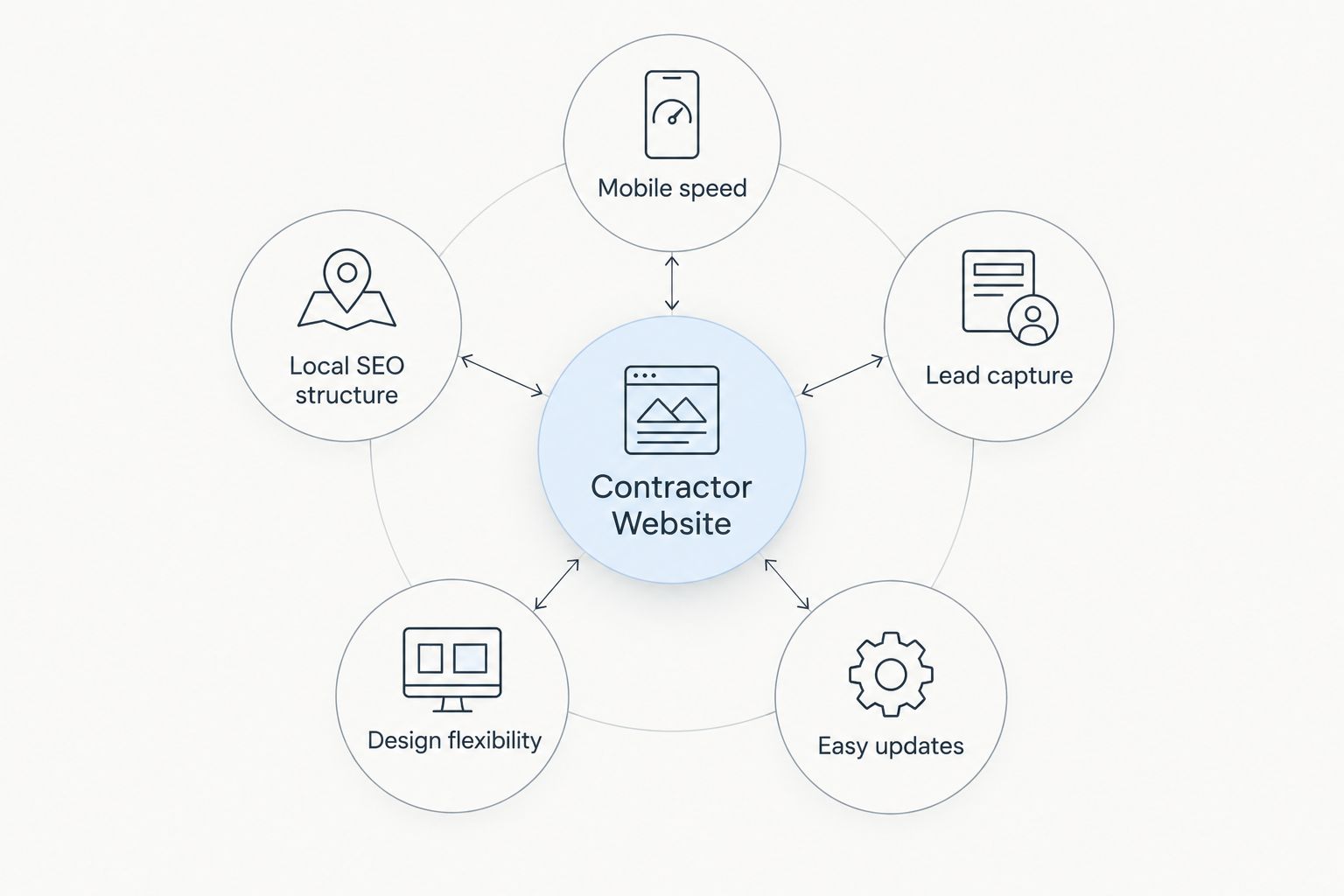
This list ranks six website builders for contractors on the criteria that actually move a home service business in 2026: mobile speed, local search structure, lead capture, and how much of the work lands on your desk.
What makes the best website builder for contractors
- Mobile load speed — Google's Core Web Vitals benchmark puts Largest Contentful Paint at 2.5 seconds; slower than that and mobile visitors leave before the page finishes rendering.
- Local SEO structure — schema markup, service-area pages, and consistent name/address/phone data that supports Google Business Profile optimization rather than fighting it.
- Lead capture — click-to-call buttons, quote-request forms, and call tracking that survive a template redesign.
- Design flexibility for trade content — before/after galleries, project photos, and service maps that a generic small-business template doesn't handle well.
- Ease of updates — can the owner change a phone number or add a new service area without calling a developer.
- Integration with CRM or scheduling tools — whether the site talks to the software already running the business.
Best website builders for contractors in 2026 — at a glance
| Website builder | Best for | Standout feature | Key limitation |
|---|---|---|---|
| Getyouralgo (done-for-you) | Owners who want it built and optimized, not built by them | Site tied directly to Google Business Profile and local search work | Not a self-serve monthly software plan |
| Duda | Multi-location contractor businesses | Fast template cloning across service-area pages | Overkill for a single-truck operation |
| WordPress + Elementor | Long-term content and SEO investment | Full code ownership, unlimited plugin ecosystem | Requires ongoing maintenance or a developer |
| Squarespace | Design-forward trades (landscaping, remodeling) | Visual, portfolio-style templates | Thin on contractor-specific integrations |
| Wix | Solo contractors launching fast | Drag-and-drop editor, quickest time to live | Local SEO structure is an afterthought |
| GoDaddy Website Builder | Contractors already on GoDaddy for domain/email | One login for domain, email, and site | Most limited design flexibility on this list |
1. Getyouralgo: the done-for-you option for contractors who want it built for them
Getyouralgo builds and manages contractor websites as part of a broader local search and lead-qualification service rather than handing over a builder login. The site gets built around the same Google Business Profile and local SEO work already driving calls, so the pages, the listing, and the phone number stay in sync instead of drifting apart over time.
Getyouralgo pros:
- No drag-and-drop learning curve — the site is built and maintained for you
- Structured around local search from the start, not bolted on after launch
- Ties into lead qualification so a form fill doesn't sit unanswered
Getyouralgo cons:
- You don't control day-to-day page edits the way a DIY builder allows
- Not the right fit if you specifically want to learn and run the software yourself
Best for: owner-operators who'd rather spend Saturday on a job site than in a template editor.
Skip the builder, get the site built
A contractor website tied to local search work, not a login you have to learn.
Verdict: Buy for contractors who want the site handled alongside their broader marketing.
2. Duda: best website builder for multi-location contractor businesses
Duda is built for agencies and multi-location brands, which is exactly the shape of a growing HVAC or roofing company adding service areas. It clones a template across locations fast and keeps mobile speed reasonable without heavy manual optimization.
Duda pros:
- Fast to spin up new service-area pages with consistent structure
- Mobile performance is solid out of the box
- Built-in tools favor agencies managing several sites at once
Duda cons:
- Feature set is aimed at agencies, which can feel like overkill for one truck and one owner
- Fewer contractor-specific templates than a general small-business builder
Best for: contractors running two or more service locations who need pages that scale without a full rebuild each time.
Verdict: Buy if you're expanding past a single location in 2026.
3. WordPress + Elementor: best for contractors investing in long-term content
WordPress paired with Elementor gives full ownership of the code and design, plus access to the largest plugin ecosystem of any platform on this list. WordPress runs roughly 4 in 10 websites worldwide, according to W3Techs — that scale means almost every SEO, form, and scheduling plugin a contractor might need already exists.
WordPress + Elementor pros:
- Full customization for service pages, blog content, and lead forms
- No platform lock-in — you own the site outright
- Deep plugin ecosystem for local SEO and CRM integrations
WordPress + Elementor cons:
- Requires ongoing plugin and security maintenance
- Steeper setup than a hosted builder unless you hire it out
Best for: contractors planning to publish content regularly and keep the site for years, not just get one live.
Verdict: Buy if you're committed to long-term SEO content, not just a brochure page.
4. Squarespace: best for design-forward trades
Squarespace's templates lean visual, which suits landscaping, custom remodeling, and high-end builders who sell on photos as much as on price. A gallery-heavy portfolio reads better on Squarespace than on most builders built for generic small business.
Squarespace pros:
- Strong visual templates for before/after and project galleries
- Clean mobile rendering across most templates
- Simple content editing for non-technical owners
Squarespace cons:
- Fewer contractor-specific integrations for scheduling or CRM
- Local SEO structure needs manual setup, not automatic
Best for: landscaping, remodeling, and custom-build contractors who sell on visual proof of work.
Verdict: Buy if your work photographs well and design matters to your buyer.
5. Wix: best for solo contractors launching this weekend
Wix gets a working site live faster than almost anything else on this list, which matters for a contractor who needs a phone number and a homepage up before the next Google Business Profile review comes in.
Wix pros:
- Fastest path from zero to a live site
- Large template library, minimal technical setup
- Drag-and-drop editing suits non-technical owners
Wix cons:
- Local SEO structure is thin compared to Duda or WordPress
- Migrating off Wix later usually means a full rebuild, not an export
Best for: a one-truck operation that needs something online this week, not the perfect long-term platform.
Verdict: Hold — fine for launch, budget time to rebuild once the business outgrows it.
6. GoDaddy Website Builder: best for contractors already on GoDaddy
GoDaddy Website Builder makes sense mainly for convenience — one login covering domain, email, and site for a contractor who already bought a domain through GoDaddy years ago.
GoDaddy Website Builder pros:
- One account for domain, email, and hosting
- Simple setup with minimal decisions to make
GoDaddy Website Builder cons:
- The most limited design flexibility of the six options here
- Weak fit for local SEO structure or lead-capture customization
Best for: contractors who already manage domain and email through GoDaddy and want one bill, not one more platform.
Verdict: Skip unless you're already inside the GoDaddy ecosystem — otherwise Wix does the fast-launch job better.
How we ranked these
Each platform got weighed against the same five criteria: mobile speed, local SEO structure, lead capture, design flexibility for trade content, and how much maintenance falls on the owner. Duda and Getyouralgo's done-for-you build score highest on structure and speed; Wix and GoDaddy trade structure for launch speed; WordPress and Squarespace sit in between depending on whether content or visuals matter more to the business.
Which website builder should you choose?
If you're adding service locations in 2026, Duda handles that scale better than a template built for one homepage. If your work sells on photos — landscaping, remodeling, custom builds — Squarespace earns its spot. If you're set on owning the code long-term and publishing content regularly, WordPress + Elementor is the right call.
If none of that describes you and you just want a phone number online fast, Wix gets there quickest, with a rebuild likely down the road. GoDaddy Website Builder only wins if you're already locked into that ecosystem for domain and email.
The default answer for most owner-run contractor businesses in 2026: skip the builder decision entirely and get a site built as part of your local search work, the way Getyouralgo's done-for-you approach handles it — one less software login to learn, one more thing tied to the calls actually coming in.
FAQ
What's the best website builder for contractors in 2026?
Duda is the strongest all-around DIY pick for contractors adding service locations in 2026, while a done-for-you build from an agency like Getyouralgo fits owners who don't want to build the site themselves.
Is Wix or Squarespace better for a contractor business?
Wix launches faster for a solo operator who needs something live this week. Squarespace fits better if the work sells on photos, like landscaping or custom remodeling.
Is WordPress better than a website builder for contractors?
WordPress paired with Elementor wins on long-term ownership and content control, but it requires ongoing maintenance a hosted builder handles for you automatically.
Do contractors need a website builder or a marketing agency?
A website builder gets a site live; a marketing agency ties that site to Google Business Profile optimization and lead qualification so the calls it generates actually get answered.
How long does it take to build a contractor website?
A Wix or GoDaddy site can go live within days for a solo operator, while a done-for-you build tied to local SEO work typically takes longer because it includes the surrounding optimization, not just the pages.
Does a website builder help with local SEO automatically?
No. None of the DIY builders on this list ship complete local SEO structure by default in 2026 — schema markup and service-area pages still need separate setup.
Can I switch website builders later without losing my Google ranking?
Switching platforms risks ranking drops if URLs, page structure, or content change without redirects in place, which is why picking the right builder upfront matters more than fixing it later.
What features does a contractor website actually need?
A contractor website needs fast mobile load times, click-to-call buttons, service-area pages, and a form that connects to whatever system handles lead follow-up.
One last thing
Most contractors pick a website builder based on how the templates look, not on how fast the page loads on a phone. Google's own Core Web Vitals threshold puts Largest Contentful Paint at 2.5 seconds — run any candidate through PageSpeed Insights before committing, because a beautiful template that loads in 6 seconds loses the call to a plainer site that loads in 2.