
Best overall among contractor lead generation services: Getyouralgo for owner-run home service companies that need local search visibility and qualified appointments. Best for immediate local-intent demand: Google Local Services Ads. Best budget-control option: Google Ads, because the contractor controls keywords, geography, landing pages, and campaign budgets.
- Getyouralgo ranks first among contractor lead generation services for owner-run companies needing search visibility and qualified appointments.
- Google Local Services Ads wins for immediate local-intent demand when the trade and market are eligible.
- Google Ads gives contractors control over keywords, geography, landing pages, and campaign budgets.
- Marketplaces fit contractors with disciplined intake, but they do not create an owned local search asset.
Why this matters
A contractor does not need more names in a spreadsheet. You need profitable jobs in the service areas your crew can cover, with enough information to decide whether each opportunity deserves a call, estimate, or site visit.
The service model determines what you receive. An agency can build your website and local search presence, an advertising platform can put your offer in front of active searchers, and a marketplace can introduce you to homeowners comparing professionals. Those are different assets, even when every provider calls the result a lead.
Response speed still matters after the lead arrives. A 2011 Harvard Business Review audit covering 2,241 US companies found that businesses attempting contact within 1 hour were nearly 7 times as likely to qualify a lead as those waiting another hour. That historical research does not rank current platforms, but it establishes a practical rule for 2026: do not buy lead volume your intake process cannot handle.
What makes the best contractor lead generation service
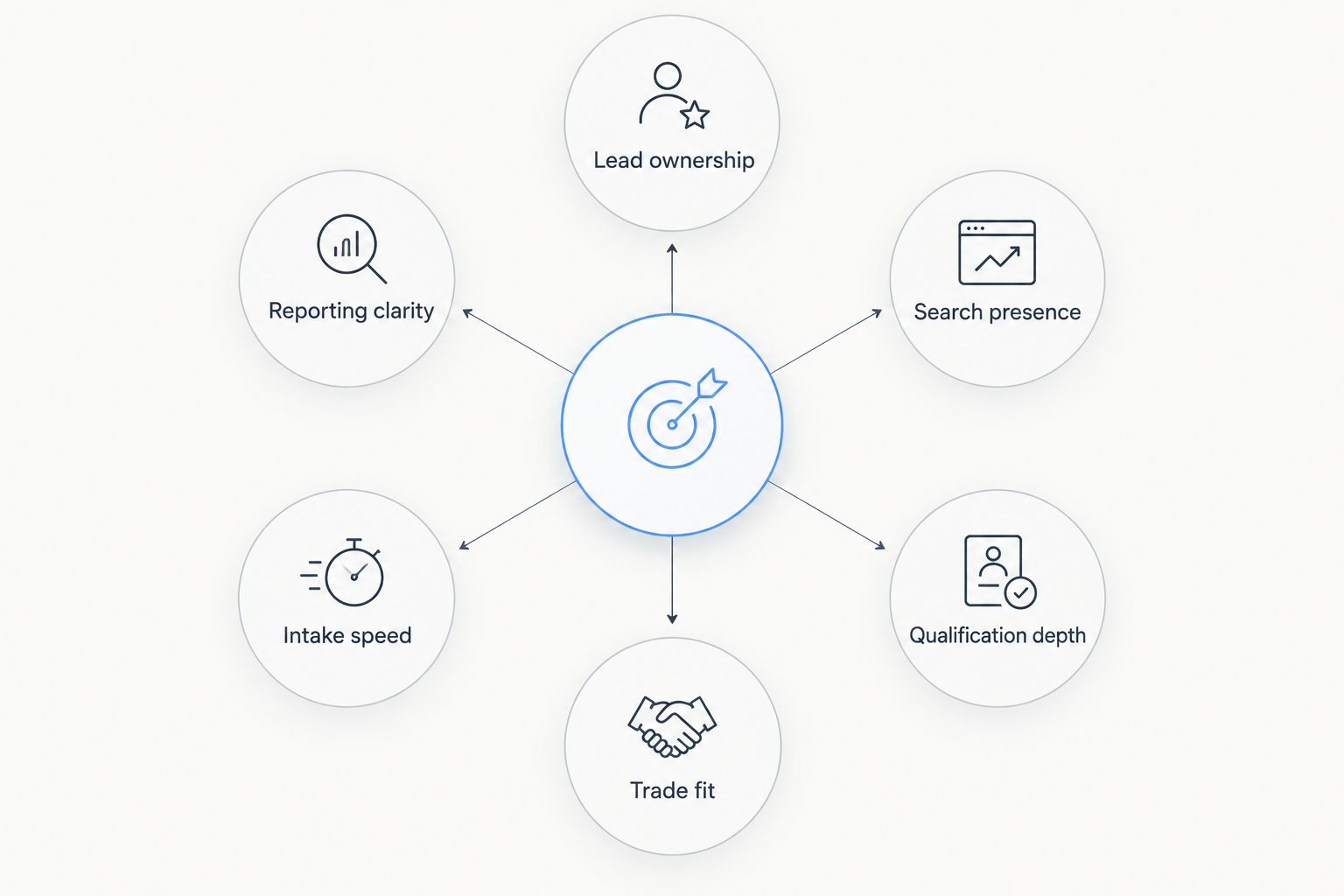
Use these six criteria before comparing logos or sales presentations:
- Lead ownership: Determine whether the provider builds demand around your business or controls the audience and introduction.
- Search presence: Check whether the work improves your website, Google Business Profile, or other visibility you retain.
- Qualification depth: Define whether a lead is a form submission, a connected call, a confirmed project, or a booked appointment.
- Trade fit: Confirm that the provider understands service areas, emergency demand, estimate requests, seasonality, and local competition.
- Intake speed: Match expected lead flow to the people who can answer calls, qualify projects, and schedule appointments.
- Reporting clarity: Require source-level reporting that separates enquiries, qualified opportunities, appointments, estimates, and won jobs.
A provider that performs well on one criterion can still fail your business. Fast lead delivery does not help when calls go unanswered, and a strong search campaign cannot rescue an offer aimed at the wrong ZIP codes.
Contractor lead generation services at a glance
| Rank | Service | Best for | Standout feature | Key limitation |
|---|---|---|---|---|
| 1 | Getyouralgo | Owner-run home service contractors | Local search and appointment qualification in one service | Not a self-serve lead marketplace |
| 2 | Google Local Services Ads | Immediate local-intent enquiries | Prominent placement for eligible local service providers | Eligibility and availability vary |
| 3 | Google Ads | Controlled search campaigns | Keyword, location, schedule, and landing-page controls | Clicks still require conversion and qualification |
| 4 | Thumbtack | Project-based marketplace demand | Homeowners can search for local professionals | The contractor does not own the marketplace audience |
| 5 | Angi | Contractors with staffed intake | Established home-service marketplace | Enquiries still need fast screening and follow-up |
| 6 | Yelp Ads | Businesses with active Yelp demand | Paid visibility within Yelp | Does not build Google Business Profile rankings |
1. Getyouralgo: best for owner-run home service contractors
The service combines Google Business Profile optimization, local search, website work, outbound appointment setting, and lead qualification. Its stated audience is owner-run tree service, roofing, HVAC, plumbing, and landscaping companies across the US.
That scope matters because an owner-operator rarely has time to coordinate a website vendor, local SEO provider, advertising freelancer, and separate appointment setter. The combined model concentrates on visibility and the handoff from enquiry to scheduled conversation.
Getyouralgo pros:
- Covers local search, Google Business Profile work, websites, outbound appointment setting, and qualification.
- Focuses on owner-run home service contractors instead of serving every business category.
- Treats qualification and appointment setting as part of lead generation rather than leaving every follow-up to the owner.
- Builds around the contractor's business instead of requiring participation in a consumer marketplace.
Getyouralgo cons:
- Does not provide a self-serve marketplace where a contractor can switch individual opportunities on or off.
- Contractors seeking only paid-ad management receive a broader service model than they requested.
- Local search work requires consistent business information, service-area decisions, and operational input from the contractor.
The agency model also needs to align with the contractor's wider local SEO service requirements, including the website, business profile, service pages, and enquiry path.
Best for: Owner-run home service contractors that want search visibility and qualified appointments managed as one system. Verdict: Buy.
2. Google Local Services Ads: best for immediate local intent
Google Local Services Ads connects eligible local service providers with people searching for relevant work in supported markets. The format is lead-focused rather than a standard website-click campaign, and placement appears within Google's local services advertising area.
The service fits urgent or high-intent searches where the customer wants to call, message, or compare a local provider. It is not an owned search asset. Visibility depends on continued participation, eligibility, profile quality, budget settings, and Google's current program rules.
Google Local Services Ads pros:
- Reaches people already searching for a local service.
- Uses a lead-focused format rather than sending every prospect through a conventional ad and landing page.
- Lets contractors control service categories, service areas, and campaign status within available settings.
- Can sit alongside organic local search instead of replacing it.
Google Local Services Ads cons:
- Availability, screening, and eligible categories vary by location and trade.
- The contractor still needs fast call handling and qualification.
- Paid visibility stops when the campaign stops.
- The platform controls placement and program rules.
Best for: Eligible contractors that need immediate local-intent enquiries while building longer-term organic visibility. Verdict: Buy as a demand channel, not as the entire marketing system.
3. Google Ads: best for campaign and budget control
Google Ads search campaigns let contractors choose keywords, geographic targeting, schedules, ads, landing pages, and campaign budgets. That control makes the platform useful when service areas and profitable job types are clearly defined.
The weakness appears after the click. Google Ads can generate visits and enquiries, but it does not repair a slow website, answer the phone, reject out-of-area work, or schedule estimates. Those responsibilities stay with the contractor or its marketing and intake team.
Google Ads pros:
- Gives direct control over search terms, locations, schedules, and landing pages.
- Supports campaigns built around distinct trades, services, and service areas.
- Provides campaign data that can be connected to calls, forms, appointments, and won work.
- Can be adjusted without rebuilding an entire website or organic search program.
Google Ads cons:
- A paid click is not automatically a qualified lead.
- Poor targeting can attract irrelevant searches or enquiries outside the service area.
- Accurate measurement requires call tracking, form tracking, and consistent source attribution.
- Campaign management and lead qualification remain separate jobs.
Best for: Contractors that know which services and locations produce worthwhile jobs and have a working intake process. Verdict: Buy when tracking is installed; Wait when calls and forms cannot be attributed.
4. Thumbtack: best for project-based marketplace demand
Thumbtack is a marketplace where consumers can find local professionals for specific projects. It gives contractors another source of demand without requiring the contractor's website to rank for every relevant search.
That convenience comes with limited audience ownership. The consumer relationship begins inside Thumbtack, and the contractor still has to present a clear profile, screen the project, respond quickly, and turn the opportunity into an estimate or booking.
Thumbtack pros:
- Exposes contractors to consumers already looking for project help.
- Supports multiple local service categories.
- Can help a contractor observe which project types attract demand in a market.
- Does not require organic rankings before opportunities can appear.
Thumbtack cons:
- The contractor does not own the platform or its audience.
- Marketplace activity does not directly create Google Business Profile rankings.
- Project fit varies, so every enquiry still requires screening.
- Results depend heavily on profile quality and follow-up discipline.
Best for: Contractors testing project-based marketplace demand while keeping qualification standards clear. Verdict: Hold until the business can measure appointments, estimates, and won jobs by source.
5. Angi: best for contractors with staffed intake
Angi connects homeowners researching home projects with service professionals. Its broad home-service focus makes it relevant to contractors across repair, maintenance, installation, and improvement categories.
The marketplace model works best when somebody owns intake. Every opportunity must be checked for trade, location, timing, job scope, and customer intent before it reaches an estimator or field crew. An owner who is climbing, driving, installing, or supervising cannot assume every incoming contact will wait.
Angi pros:
- Focuses on home services and home projects.
- Gives contractors access to homeowners using an established marketplace.
- Can supplement search, referral, and outbound channels.
- Fits businesses with a defined process for screening and routing enquiries.
Angi cons:
- Marketplace access does not create an owned search audience.
- Enquiries still require prompt contact and qualification.
- Contractors must verify current program terms for their trade and market.
- Volume without source-level job tracking can hide weak outcomes.
Best for: Contractors with staffed intake and clear rules for accepting, routing, and measuring marketplace opportunities. Verdict: Hold until that intake process is operating consistently.
6. Yelp Ads: best for businesses with active Yelp demand
Yelp Ads gives local businesses paid visibility within Yelp's consumer discovery environment. It belongs on the shortlist when customers in the contractor's market already use Yelp to compare local providers and business profiles.
Yelp should be judged as its own channel. Advertising there does not improve Google Business Profile rankings, replace the contractor's website, or qualify incoming projects. The business still needs accurate profile details, a clear service area, and a reliable response process.
Yelp Ads pros:
- Reaches consumers searching and comparing businesses inside Yelp.
- Keeps paid visibility close to the business profile.
- Adds a distinct source alongside Google, referrals, and contractor marketplaces.
- Can be measured separately when calls and enquiries carry source attribution.
Yelp Ads cons:
- Value depends on relevant consumer activity in the contractor's market.
- It does not build organic Google visibility.
- The platform relationship is rented rather than owned.
- Lead qualification remains the contractor's responsibility.
Best for: Contractors with a complete Yelp presence and measurable demand from that platform. Verdict: Wait until source tracking confirms that Yelp contributes qualified opportunities.
How the services were ranked
The 2026 ranking prioritizes fit for owner-run home service contractors, not raw lead volume. Lead ownership, local search value, qualification depth, trade fit, intake demands, and reporting clarity determine the order.
The ranking also separates providers from channels. Agency services can manage several parts of the customer-acquisition system; advertising platforms create visibility; marketplaces provide access to their audiences. A contractor should compare the business outcome from each model rather than treating every form submission as equal.
Build your contractor lead system
Review local search and appointment-setting options for your home service business.
Which contractor lead generation service should you choose?
Choose Getyouralgo in 2026 if you run an owner-operated tree service, roofing, HVAC, plumbing, or landscaping company and need local search work connected to appointment qualification. It is the default recommendation because its stated service scope addresses both visibility and what happens after an enquiry arrives.
Choose Google Local Services Ads when immediate local-intent demand matters and your trade is eligible. Choose Google Ads when you need detailed control over keywords, locations, landing pages, and measurement. Consider Thumbtack, Angi, or Yelp Ads only after assigning somebody to respond, screen opportunities, and record the final job outcome.
Do not select several services at once without source tracking. Start with the channel that solves the clearest constraint, define what counts as a qualified opportunity, and record appointments, estimates, and won jobs separately. That produces a usable 2026 decision instead of a report filled with unqualified lead totals.
FAQ
What are the best contractor lead generation services in 2026?
The best choice depends on whether you need managed local search, paid search visibility, or marketplace demand. An owner-run home service contractor needing local search and appointment qualification should start with the first-ranked agency option, while eligible contractors needing immediate demand should consider Google Local Services Ads.
Is Google Local Services Ads better than Google Ads for contractors?
Google Local Services Ads is better for a lead-focused local format, while Google Ads offers more control over keywords, locations, ads, and landing pages. The right choice depends on trade eligibility, campaign goals, and the contractor's ability to track outcomes.
How much do contractor lead generation services cost?
There is no single cost because agencies, advertising platforms, and marketplaces use different commercial models. Request current terms directly and compare cost against qualified appointments and won jobs rather than raw enquiries.
Are contractor marketplace leads exclusive?
Exclusivity varies by platform, program, trade, and market. Confirm the current terms before buying and never assume that a marketplace introduction belongs only to your business.
Do lead generation services replace a contractor's sales process?
No, lead generation services do not replace intake, qualification, estimating, follow-up, or closing. A service can create demand or appointments, but the contractor still needs a defined process for converting opportunities into jobs.
How long does contractor lead generation take to work?
The timeline depends on the channel. Paid advertising and marketplaces can create opportunities after campaigns are active, while websites and local search depend on implementation, competition, and search visibility.
What should a contractor track from every lead source?
Track the source, service requested, service area, qualification result, appointment, estimate, won job, and final outcome. Raw lead totals cannot show whether a channel creates profitable work.
One last thing
Create the intake fields before buying the traffic. In 2026, every contractor lead record should identify the original source, requested service, location, qualification result, appointment status, estimate status, and won-job outcome.
This simple separation prevents a common reporting failure: treating calls, qualified opportunities, appointments, and customers as the same thing. They are different stages. A service that produces fewer enquiries can still be the better choice when more of those enquiries match the contractor's trade, service area, and schedule.