The best CRM software for HVAC companies in 2026 splits by shop size: ServiceTitan wins overall for mid-size and enterprise HVAC operations running ten or more trucks, Housecall Pro wins for solo operators and two-to-five tech crews, and Service Fusion wins on budget for small teams that need core CRM and dispatch without paying for modules they'll never open.
- ServiceTitan is the best crm software for hvac companies with enterprise dispatch, financing, and marketing attribution built in.
- Housecall Pro fits owner-operators and small crews who need booking, invoicing, and a simple client hub.
- FieldEdge is the only pick on this list built around HVAC-specific flat-rate pricebooks.
- Service Fusion is the budget option for shops that just need CRM and dispatch, not a full platform.
- A CRM organizes leads you already have — it does not generate the calls that fill your dispatch board in 2026.
Why this matters
A CRM decides whether a missed call turns into a booked job or a lost lead. HVAC shops run on repeat customers, seasonal spikes, and referral jobs, and a system that drops a lead between the phone call and the technician's truck costs real revenue every month.
Most HVAC owners buy CRM software to fix the same three problems: technicians showing up to jobs with no history on the account, office staff re-entering the same customer three times, and marketing spend that nobody can trace back to booked revenue. The right software fixes the first two. It does not fix the third — that's a lead generation and HVAC marketing agency problem, and it's worth separating the two before you sign a contract in 2026.
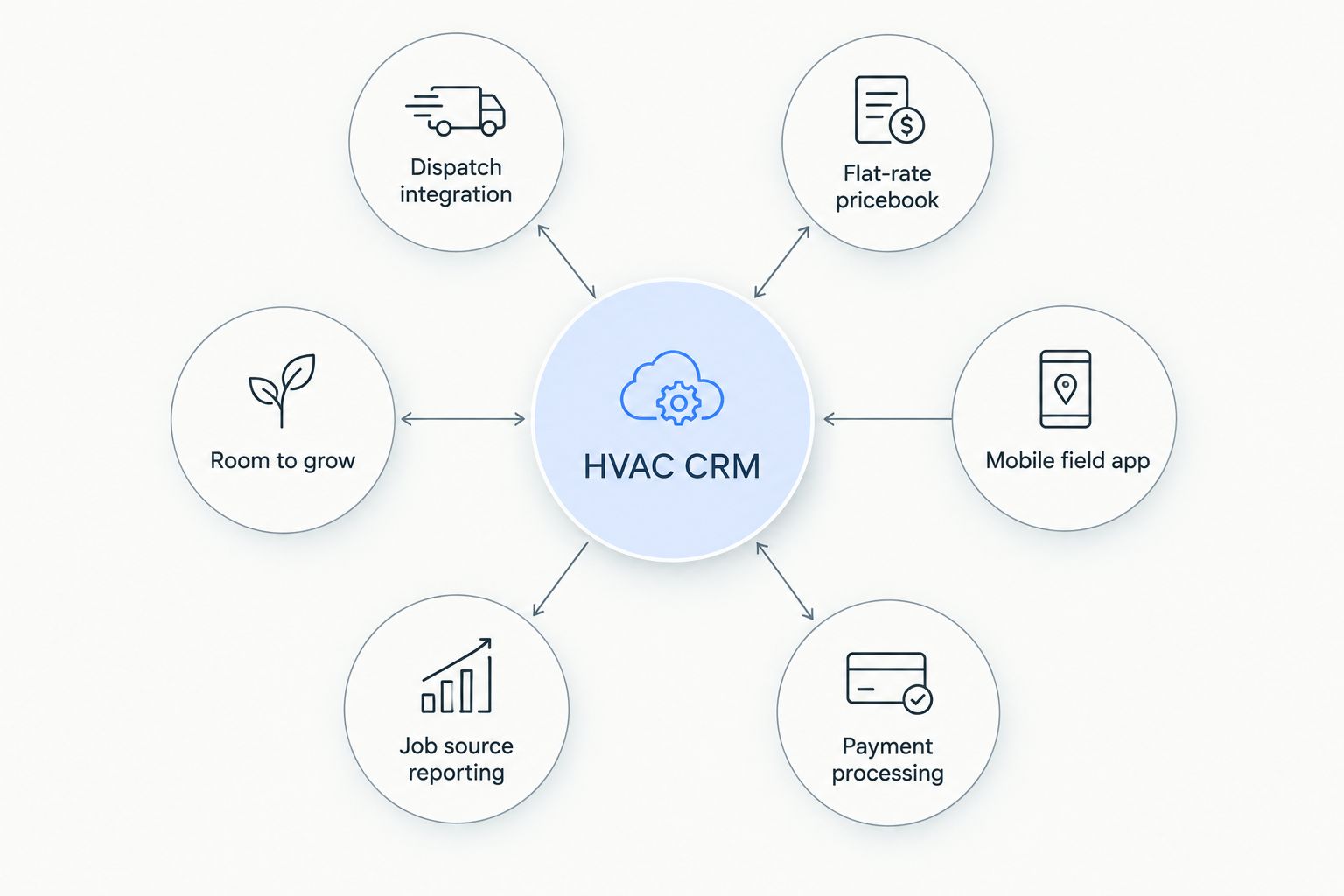
What makes the best CRM software for HVAC companies
- Dispatch and scheduling integration — the CRM and the dispatch board share one customer record, not two.
- Flat-rate pricebook support — technicians quote from a standard price list in the field, not a paper binder.
- Mobile field app — techs pull job history, photos, and payment on a phone, not a laptop back at the shop.
- Payment processing and invoicing — the tech closes the job and collects payment before leaving the driveway.
- Reporting on job source — the CRM tags where a lead came from, so you can see which marketing actually converts.
- Integration room to grow — the platform connects to accounting software and doesn't lock you into one vendor for everything.
HVAC CRM software at a glance
| Software | Best for | Standout feature | Key limitation |
|---|---|---|---|
| ServiceTitan | Large HVAC companies (10+ trucks) | Marketing attribution tied to booked revenue | Steep onboarding, built for scale you may not have yet |
| Housecall Pro | Solo operators and small crews | Online booking plus built-in payments | Reporting depth lags behind enterprise platforms |
| Jobber | Multi-trade contractors running HVAC plus other services | One client hub across every trade you offer | No HVAC-specific flat-rate pricebook |
| FieldEdge | HVAC-specific flat-rate pricing and dispatch | Pricebook built for HVAC parts and labor codes | Interface feels dated next to newer competitors |
| Service Fusion | Budget-conscious small HVAC shops | Core CRM, dispatch, and invoicing without extra modules | Fewer marketing and reporting integrations |
| Successware | Multi-location or franchise HVAC operations | Franchise-level financial dashboards | Overkill for a single-location shop |
1. ServiceTitan: best CRM software for HVAC companies for large operations
ServiceTitan is a field service management platform built for HVAC, plumbing, and electrical contractors running fleets, not single trucks. It combines CRM, dispatch, marketing attribution, and financing options for customers who need to spread out a big-ticket install.
ServiceTitan pros:
- Marketing attribution ties booked revenue back to the specific ad or call that generated it.
- Deep reporting on technician performance, membership renewals, and average ticket size.
- Built-in financing options for large equipment replacements.
ServiceTitan cons:
- Onboarding takes weeks and usually needs a dedicated admin to manage it.
- Priced and built for shops with the call volume to justify the feature set.
Best for: HVAC companies with 10+ trucks and an office staff that can run a full platform. Verdict: Buy if you're past the ten-truck mark; Skip if you're a two-tech shop.
2. Housecall Pro: best CRM software for HVAC companies for solo operators and small crews
Housecall Pro handles booking, invoicing, and a client-facing hub for HVAC shops with one to five technicians. It's built to be usable without training a new hire for a week first.
Housecall Pro pros:
- Online booking lets customers schedule without a phone call.
- Payment processing is built in, so techs collect on-site.
- Mobile app is straightforward enough for a tech who's never used a CRM.
Housecall Pro cons:
- Reporting is thinner than what enterprise platforms offer.
- Pricebook customization is limited on entry tiers.
Best for: owner-operators and two-to-five-tech HVAC shops. Verdict: Buy for most owner-run shops in this size range.
3. Jobber: best CRM software for HVAC companies running multiple trades
Jobber serves contractors who don't do HVAC exclusively — the same owner might run heating and cooling calls alongside plumbing or handyman work. One client hub covers every trade under one account.
Jobber pros:
- Single CRM record works across every service line you offer.
- Quoting and invoicing are fast to set up.
- Client hub gives customers a self-serve portal for scheduling and payment.
Jobber cons:
- No HVAC-specific flat-rate pricebook.
- Dispatch board is lighter than platforms built for larger fleets.
Best for: contractors who run HVAC alongside other trades. Verdict: Hold if HVAC is your only service line — pick a more HVAC-specific tool instead.
4. FieldEdge: best CRM software for HVAC companies for flat-rate pricing
FieldEdge is built specifically around HVAC and plumbing flat-rate pricebooks, so technicians quote from a standardized list of parts and labor codes instead of guessing in the driveway.
FieldEdge pros:
- Pricebook is purpose-built for HVAC parts and labor, not adapted from a general trades template.
- Deep QuickBooks integration keeps accounting in sync.
- Dispatch board routes by technician skill set.
FieldEdge cons:
- Interface feels dated compared to newer competitors on this list.
- Onboarding usually requires vendor-led training sessions.
Best for: HVAC shops that live and die by consistent flat-rate pricing. Verdict: Buy if pricebook consistency is your biggest pain point.
5. Service Fusion: best CRM software for HVAC companies on a budget
Service Fusion covers the basics — CRM, dispatch, and invoicing — without the extra modules that drive up cost on bigger platforms. It's a fit for HVAC shops that need the fundamentals working before they invest in anything more.
Service Fusion pros:
- Core CRM, dispatch, and invoicing cover the essentials.
- Setup is faster than enterprise platforms.
Service Fusion cons:
- Marketing integrations are limited compared to ServiceTitan or Housecall Pro.
- Reporting stays basic — fine for a small shop, thin for a growing one.
Best for: small HVAC shops that need the fundamentals without extra modules. Verdict: Buy for a lean, budget-first setup.
6. Successware: best CRM software for HVAC companies with multiple locations
Successware targets multi-location and franchise HVAC operations that need consistent financial reporting across every location, not just per-tech dispatch.
Successware pros:
- Franchise-level dashboards roll up performance across locations.
- Financial reporting depth suits operators managing more than one P&L.
Successware cons:
- Overkill for a single-location shop.
- Requires dedicated admin staff to keep it running well.
Best for: multi-location or franchise HVAC operators. Verdict: Hold unless you're already running more than one location.
How we ranked these
Each platform was scored against the six criteria above: dispatch integration, flat-rate pricebook support, mobile field app quality, payment processing, job-source reporting, and room to grow into other integrations. Use-case fit mattered more than feature count — a solo operator gains nothing from ServiceTitan's franchise dashboards, and a ten-truck company will outgrow Service Fusion's reporting within a year.
Which CRM software should you choose?
If you're an owner-run HVAC company with fewer than five trucks in 2026, Housecall Pro is the default pick — it covers booking, payment, and a mobile app without a multi-week onboarding process. Scale past ten trucks and ServiceTitan's attribution reporting starts paying for itself. If pricebook consistency is your actual pain point, skip both and go straight to FieldEdge.
A CRM won't fill your dispatch board
Here's the part CRM vendors don't mention: the software organizes leads you already have. It doesn't call the customer whose furnace died at 11pm, and it doesn't optimize the Google Business Profile that's the reason 60% of HVAC searches even find you in 2026. Contractors who pair a CRM with active local SEO services for contractors see the CRM's job-source reports actually fill up with data instead of sitting empty.
Getyouralgo runs Google Business Profile optimization, local search, and outbound appointment-setting for owner-run HVAC, plumbing, and roofing companies — the lead generation layer that sits above whatever CRM you pick. A CRM tells you which lead converted; Getyouralgo is the piece that makes sure the phone rings in the first place.
Get more HVAC leads into your CRM
GBP optimization and outbound appointment-setting for HVAC contractors.
FAQ
What is the best CRM software for HVAC companies in 2026?
ServiceTitan is the best overall for HVAC companies with 10+ trucks, Housecall Pro is the best for solo operators and small crews, and Service Fusion is the best budget option for shops that just need core CRM and dispatch.
Is ServiceTitan better than Housecall Pro for HVAC?
ServiceTitan offers deeper reporting and marketing attribution, but it's built for larger fleets. Housecall Pro is easier to set up and better suited to owner-operators and two-to-five-tech HVAC shops.
Does FieldEdge work for plumbing companies too?
Yes, FieldEdge is built around HVAC and plumbing flat-rate pricebooks, so it fits contractors running both service lines with a shared pricing structure.
Do small HVAC companies need a CRM in 2026?
Yes, even a one-truck HVAC shop benefits from a CRM to track customer history, schedule jobs, and process payments in the field instead of relying on paper or spreadsheets.
Can a CRM generate HVAC leads on its own?
No. A CRM organizes and tracks leads you already have; it doesn't drive new calls. Lead volume comes from local search visibility, Google Business Profile optimization, and outbound follow-up.
What's the difference between Jobber and a CRM built specifically for HVAC?
Jobber serves multi-trade contractors with one client hub across service lines, while HVAC-specific tools like FieldEdge include flat-rate pricebooks built for HVAC parts and labor codes that Jobber doesn't offer.
Is Successware worth it for a single-location HVAC shop?
Not usually. Successware is built for multi-location and franchise HVAC operators who need consolidated financial dashboards across sites — a single-location shop pays for reporting depth it won't use.
One last thing
The CRM you pick in 2026 only matters as much as the lead volume feeding it — a shop with a $30,000 ServiceTitan setup and no local search visibility loses to a two-truck competitor running Housecall Pro with a fully optimized Google Business Profile. Fix the marketing pipeline before you upgrade the software stack.